

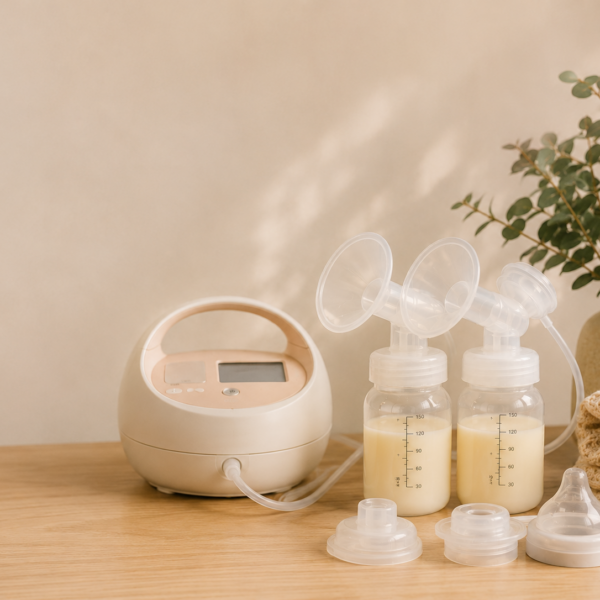
Going back to work while still feeding your baby is a logistics problem layered on top of an emotional one. Both are real. Let us take them in order, because the logistics are the part you can plan for.
Know your rights before you go back
Under the federal PUMP Act, most employees in the United States are entitled to reasonable break time to pump and a private space that is not a bathroom, shielded from view and free from intrusion. These protections generally extend through your baby’s first year.
Some employers are well set up for this. Others have simply never been asked. Going in with a clear, specific request usually goes better than hoping someone offers.
Coverage and details vary by employer size and state, and some states offer stronger protections than federal law. If your workplace pushes back, your state labor office is a good next call.
Have the conversation early
Two to four weeks before your return, ask for a short meeting and come with specifics rather than questions:
- Which room you will use, and how you will reserve it.
- Roughly when you will need breaks — most people pump every three hours or so.
- How long each session takes, including setup and cleanup. Twenty to thirty minutes is realistic.
- Where you will store milk during the day.
- Who covers your desk, patients, or classroom while you are out.
Put it in writing afterward, even a short email confirming what you agreed. That protects both of you.
Practice before day one
Do a dry run the week before. Pump at the times you plan to pump at work, wearing what you plan to wear. You will find out quickly whether that dress is workable, whether your cooler fits in your bag, and how long cleanup really takes.
This is also the time to check your flange fit. A size that felt fine during relaxed home sessions can become genuinely painful when you are pumping on a schedule, five days a week.
Building a stash — less than you think
You do not need a freezer full of milk. You need roughly one day’s worth to start, because what you pump on Monday feeds your baby on Tuesday. Somewhere between 10 and 20 ounces is a comfortable cushion for most families.
Enormous freezer stashes are mostly a social media phenomenon. They are not a benchmark, and chasing one before you return to work is a fast route to burnout and oversupply.
A realistic workday
- Morning: feed your baby directly before you leave if you can.
- Mid-morning: first pump session.
- Lunch: second session. Eat while you pump.
- Mid-afternoon: third session.
- Evening: feed directly once you are home.
Three sessions covers most eight-hour days. If your day is longer, or your supply dips, add one rather than lengthening the ones you have.
Storage, briefly
- Freshly expressed milk keeps about four hours at room temperature.
- In the fridge, about four days.
- In a standard freezer, about six months; in a deep freezer, up to twelve.
- An insulated cooler with ice packs will hold milk for about a day.
Label everything with the date. Use the oldest first. Store in small amounts — two to four ounces — so nothing gets wasted.
The part nobody warns you about
The first week back is often harder emotionally than practically. Many parents find their supply dips slightly in the first days — stress and a changed routine will do that — and then recovers once things settle.
If it does not recover, that is worth looking at properly rather than pushing through. Frequency, flange fit, pump suction, and how old your valves and membranes are all affect output, and all are fixable.
Want personalized support?
Returning to work is one of the most common reasons people call me, and one of the most fixable.
Made to Lactate offers virtual consultations, in-home visits, and seven-day postpartum support packages with a Registered Nurse and lactation coach. See the support packages →